Sunday, October 31, 2010

Coastal Erosion in Taiwan

Coastal erosion is a problem present in the majority of countries with coastline. Wind and water mechanically whether the coastlines, though rising oceans are also largely responsible for much of the erosion taking place. As ⅔ of the world is covered in ocean, it is important that the land that is available for use is protected, and that as much of the coastal environments can be maintained.
Taiwan, an island country in the Pacific, is a perfect example of a country that is facing coastal erosion as having the potential for becoming a major problem. Currently, the average vertical displacement velocity is estimated somewhere between 1-3 cm/year (Hsu). Though this is an average, there are a number of areas that have been the subject of much more substantial erosion and displacement, such as in Kaohsiung County, where more than 50 hectares of land being displaceds between 1958 and 1987 (Low 1-4).
One of the major contributing factors is human development along the shorelines as well as inland. As sand is mined out of the rivers and human constructs such as dams are built, the sediment levels drop. For example, Toucheng Beach in Ilan, once 2 Km in length, though as a result of jetties being built to protect a fishing area north of the beach, it has been rapidly disappearing over the past 10 years (Low 1-4).
Constant wave action and typhoons are also a concern in coastal erosion. Ideally, waves will transport sediment away from the beaches and shoreline, while rivers and sediments in runoff collect and stabilize the coast. However, the construction of dams and the removal of sand from rivers causes a severe decline in the replenishing of sediment by holding it from reaching the beach. This causes the waves to remove sediment that is not being replaced. Typhoons greatly accelerate this process with much more extreme conditions.
Steps are being taken, slowly, to help deter coastal erosion from occuring. For example, the Water Resources Agency passed a measure to ensure that a maximum of 40% of sand used for construction can be gathered from the local rivers and shorelines. Although this will not have an effect as easily seen as others, it will still slow the erosion rates in the coming years (Low 1-4). Additionally, research is being conducted on ‘soft’ barriers, barriers that are capable of allowing sediment to be moved up from the seafloor while catching sand being pulled away from the beaches (Peng and Jan).

“It takes time. But at least we can see that the situation is not worsening,” Hsu said. “The retreat of the coastline, while continuing over the last 10 years, is not as drastic as during the previous decade. (Low 1-4)”

Taiwan is generally a mountainous country, roughly ⅗ of the island is considered mountainous. As a result, the majority of the population is concentrated around the perimeter of the island, and a large portion of the population is dependent on the ocean directly or indirectly to support their livelihood (Hsu). As jetties and other structures are continuing to be built, its a fair assumption that the general population that will be directly affected by coastal erosion is largely unaware of the danger that exists in the structures.


Peng, Ta-Hsiung, and Chyan-Deng Jan. "FIELD EXPERIMENTAL STUDY ON A SOFT PROTECTING METHOD FOR COASTAL EROSION PREVENTION." SlideShare. East Asian Workshop on Marine Environments, 09 Nov 2009. Web. 31 Oct 2010. .

Low, Stephanie. "FEATURE: Battle of trenches in shoreline erosion war." Taipei Times March 22 2009: 1-4. Web. 31 Oct 2010. .

Hsu, Tai-Wen. "Human impact on coastal erosion in Taiwan.." Journal of Coastal Research (2007): n. pag. Web. 31 Oct 2010. .

Coastal Erosion in Britain!

            It is estimated by the Association of British Insurers that sea levels will rise 40cm around Britain by the year 2040 due to coastal erosion. If this takes place, and no human defenses are made beforehand then 130,000 more properties will be at risk of flooding. On the Northeast Coast of England in Filey, coastal erosion is occuring at a rate of 25cm a year. These numbers are not as staggering as coastal erosion in other places around the world, however estimates claim that someday in the not so distance future, England could face similar threats. The figure to the right shows coastal erosion "hot spots" in Britain. These "hot spots" have shown particularly increased rates of erosion compared to others around the country.
            The recent and projected increases in the rate of coastal erosion in Britain can be accounted for in several geologic, climatic and oceanographic processes. Geologic processes that make Britain particularly susceptible to coastal erosion include how the water interacts with the particular sediment make-up of the coastal region, structures within the bedrock formation such as bedding, joints and faults, shifts in the water table location in cliffs or sloped shore, and changes in the earth's crust. Climatic and oceanographic processes that are causing coastal erosion in Britain include increases in size and violence of waves, tidal processes, increase in sea level (which is a cause and effect...), and the increase in frequency and intensity of storms.  Accelerated global climate change is greatly shifting the  speed and intensity of climatic processes and is consequently making coastal erosion a much greater problem.
           In coastal erosion "hot spots" such as those seen above there are several human interventions that can help delay and slow the process of coastal erosion at least temporarily. These include the building of harbors, extraction of minerals from the area through processes such as beach mining, and the construction flood and coastal protection barriers. Scientists in Britain have begun to use satellite images to hopefully gain a greater understanding of change in the rate of erosion and the causes of coastal erosion. As it stands now, the best defense and option for defending against coastal erosion would be the removal of minerals because of the particular threats they face in that they have both beached areas and many cliff coast lines. Attempting preservation of cliff coastlines is particularly important in Britain because as much as 4% of employment in Britain relies on the coastlines and landslides caused by cliffs falling are dangerous both to humans and to the  economy.

Coastal Erosion in Poland and the Pomeranian Bay

By Danielle Walczak

Poland's 634km of coastline has been subject to coastal erosion for years. The coast of Poland is located on its northern border, lining the Baltic Sea (see map). Although there has been much coastal erosion throughout the coast the most affected area is that of the Pomeranian Bay, located on the west end of Poland's coastline (see map). Coastal erosion is a large issue in Poland for environmental and social/economic reasons.


60-70% of Poland's sandy coastline is subject to erosion along with recession of the shoreline that is proven to be permanent. According to many reports the shoreline recession in Poland is up to 0.5-0.9 m/year, which results in the loss of large areas of land, up to 340,000 m2/year, according to the Polish Academy of Sciences.

Focusing on the coastline of Pomeranian Bay there are many different factors that result in the loss of coastline occurring today. Although a few reports suggest that global warming is the cause, there is a large amount of research that cites both the combination of weather patterns in reaction with humans as the main cause.

In the area of the Pomeranian Bay it has been cited that there is a lot of heavy weather, strong winds resembling hurricanes, blow through the area creating large and strong waves. Although this causes erosion, it is natural. Yet as towns, too close to the sea are created there becomes a need for hard seawalls to protect the coast and homes on it from the heavy waves. Hard seawalls are formations placed off the coast, made of cemement and other materials to change the strength and direction of the waves. The problem with hard seawalls is that they often cause more erosion, requiring even more effort in coastal protection. Th combination of human inhabitants too close to the coast line, the weather patterns in the Pomeranian Bay and the hard sea walls created are causing the large amounts of coastal erosion to occur in Poland.

Although there is a natural erosion threat it has been accelerated by the building of sea walls. Another economic and social factor that may play a part in why the erosion rate is so high is that much of the Pomeranian Bay surrounded by rural areas and vacation homes. Everything is nice around the homes but steeping outside those properties there is a definite difference of cultures. Agriculture and forestry play a big role in these rural communities. Their practices are not good for the eroding coastlines either. Along with this there is also a lot of land being developed to create second homes or vacation homes for people.

There are already preventative measures being taken to try and slow down the rate of erosion on Poland's coast. There are environmentally friendly practices that are happening to remove the hard seawalls that have been in place for so long. Practices to protect undisturbed environments have also been put in place. To help reduce the problem, practices such as artificial beach nourishment should be continued and expanded. Special kinds of grass and bushes are also being put in to help strengthen dune slopes against erosion (see photo). Planting these bushes and grass has already brought back some beaches with the system of "wood-overgrown dunes" (see second photo). If the good practices listed above are continued and expanded, perhaps involving local rural workers to help in the process, then the remaining coastline of the Pomeranian Bay can be saved.
Works Cited

"15. Poland" Country Overview and Assessment. Policy Research Corp., n. d. web. 31. Oct. 2010. http://ec.eurpoa.eu/maritimeaffairs/climate_change/poland_en.pdf
Furmanczyk, Kazimierz. "Western Coast of Poland." EUROSION Case Study. U of Szczecin: Inst. od Marine Sciences, Feb. 2003. Web. 31 Oct. 2010. http://corpanet.projects.euccd.de/files/000144_EUROSION_Western_coast_of_Poland.pdf.
Zibigniew, Pruszak and Ostrowski, Rafal "Shrinking Shores: Our Beaches." Research in Progress Geology. Inst. of Hydroengineering, Gda&324;sk:Polish Acad. of Sciences, 2005. Web. 31 Oct. 2010. http://www.english.pan.pl/images/stories/pliki/publiki cje/academia/2005/05/24-25_pruszak.pfd.


Wednesday, October 27, 2010

Coastal Erosion in Alaska

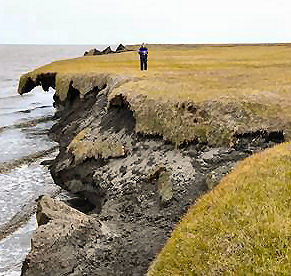
Coastal erosion is an enormous problem in our world today and occurs along beaches and shorelines. Both wind action and water action have important parts in this process and constantly change the boundary between land and water. Coastal erosion takes land away forever from one area to deposit it someplace else.With 80% of the state’s population and 30,000 plus miles of coastline, it is a problem that must be addressed.
The Arctic Coastal Plain of northern Alaska as well as the coast of the Beaufort Sea are areas of economic importance to the United States. These areas are also home to remote Native American communities that have unique habitats of global significance as well as rare species of animals.
Unfortunately for these areas, coastal erosion in Alaska has more than doubled in the past 50 years going from an erosion rate of 20 ft per year to its now staggering rate of 45 ft per year, and is still increasing. Not only is the growing erosion rate affecting communities and species but it is also greatly affecting the states growing oil industry, which is a problem for everyone.
One of the main things that is causing this erosion to increase, is a reduced sea ice cover in the Arctic Ocean, which is responsible for increasing coastal exposure to waves, resulting in an increase of erosion. Global warming is also a huge factor in the increasing erosion rate in Alaska, as well as the increasing warmth of sea water. Because of these many factors a decrease in erosion is very unlikely and if anything the erosion rate will only continue to increase.Erosion of sand dunes on beaches is often controlled by planting certain plants that have extensive root structures. This helps hold the dune together, and is affective, although is not a particularly good way to avoid the problem in Alaska. Something that we can do to try and help reduce the erosion rate is do whatever we can to reduce global warming. One method of prevention is to build sea walls and bulkheads, made out , vinyl, and concrete.
Something that the state would like to set into action is a bylaw that does not allow people to occupy land within a certain distance from the coast or unstable slopes.
This graph shows the decrease of ice in the Arctic Sea in the past 25 years. This decrease in ice causes an increase in water flow, leading to an increase in erosion.

Graph of September average Arctic sea ice extent.
Add caption