Coastal erosion is an enormous problem in our world today and occurs along beaches and shorelines. Both wind action and water action have important parts in this process and constantly change the boundary between land and water. Coastal erosion takes land away forever from one area to deposit it someplace else.
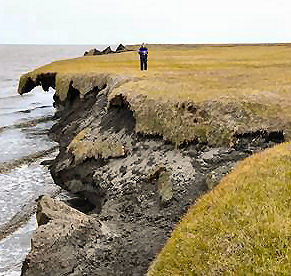
The Arctic Coastal Plain of northern Alaska as well as the coast of the Beaufort Sea are areas of economic importance to the United States. These areas are also home to remote Native American communities that have unique habitats of global significance as well as rare species of animals.
Unfortunately for these areas, coastal erosion in Alaska has more than doubled in the past 50 years going from an erosion rate of 20 ft per year to its now staggering rate of 45 ft per year, and is still increasing. Not only is the growing erosion rate affecting communities and species but it is also greatly affecting the states growing oil industry, which is a problem for everyone.
One of the main things that is causing this erosion to increase, is a reduced sea ice cover in the Arctic Ocean, which is responsible for increasing coastal exposure to waves, resulting in an increase of erosion. Global warming is also a huge factor in the increasing erosion rate in Alaska, as well as the increasing warmth of sea water. Because of these many factors a decrease in erosion is very unlikely and if anything the erosion rate will only continue to increase.Erosion of sand dunes on beaches is often controlled by planting certain plants that have extensive root structures. This helps hold the dune together, and is affective, although is not a particularly good way to avoid the problem in Alaska. Something that we can do to try and help reduce the erosion rate is do whatever we can to reduce global warming. One method of prevention is to build sea walls and bulkheads, made out , vinyl, and concrete.
Something that the state would like to set into action is a bylaw that does not allow people to occupy land within a certain distance from the coast or unstable slopes.
This graph shows the decrease of ice in the Arctic Sea in the past 25 years. This decrease in ice causes an increase in water flow, leading to an increase in erosion.
 |
| Add caption |

No comments:
Post a Comment